Love Reading?
Articles
Find our blog posts and media articles all in one place!
Firm Foundations (Part 2)
Firm Foundations:
Have We Got The Base Right? (Part 2)
In Part 1, I discussed the idea of changing our training plans to suit the horse’s needs and how broadening the world of a cautious horse might not be the right step to take. Here, in Part 2, I also bring in the role of enrichment and discuss how the right enrichment can also make the world of difference to our training goals
Enrichment needs a foundation too
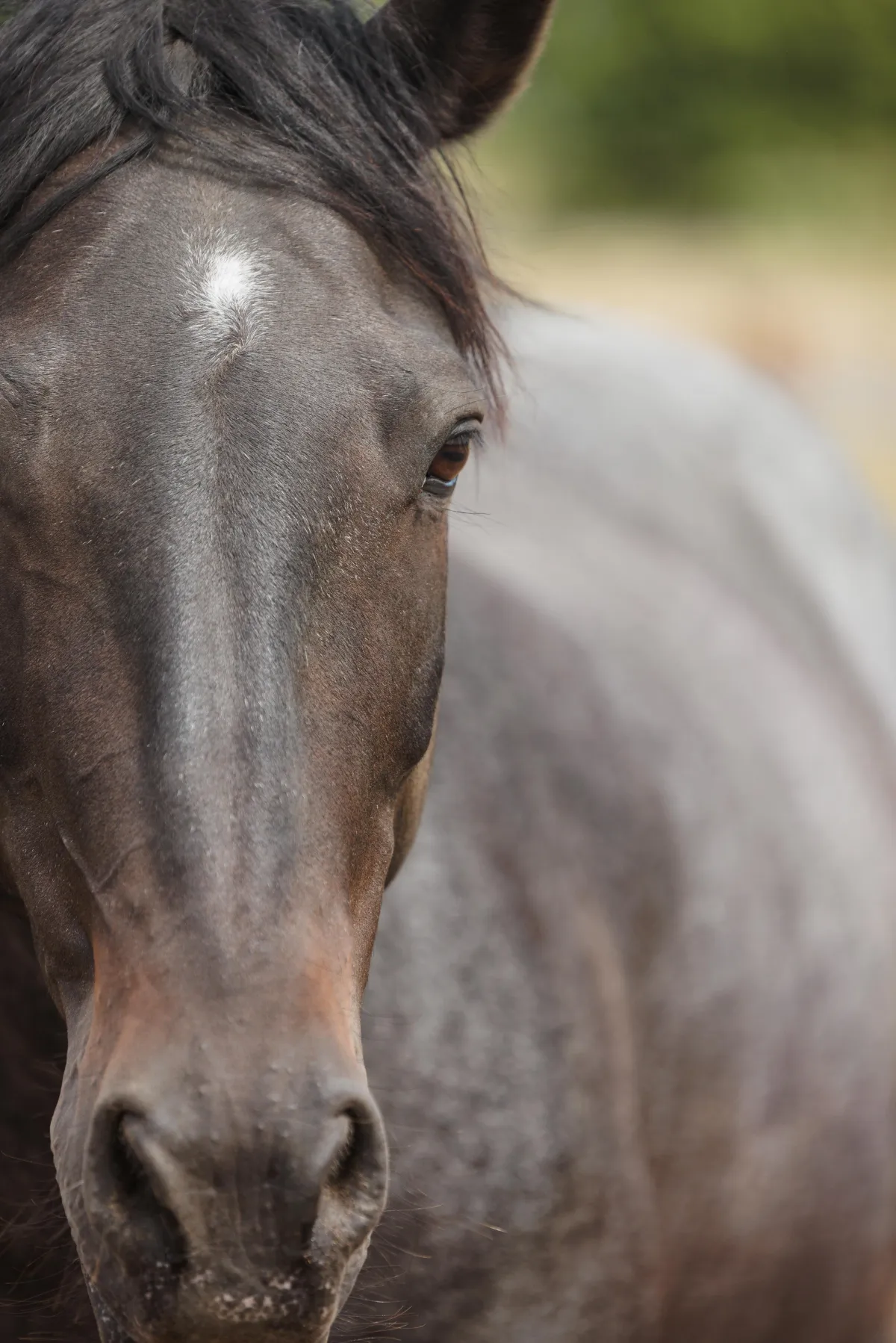
In addition to reconsidering my training plans, taking on Blue has also made me think more deeply about enrichment.
🌿One of my biggest realisations over the past few weeks has been that enrichment doesn't just happen.
On the whole, the domestic environments we create for horses aren't inherently rich in opportunities. We determine where horses live, where they can go, who they interact with, how food is presented and much of what happens during their day. ✏️
If we want to provide meaningful opportunities for exploration, foraging, choice, problem-solving and other species-relevant behaviours, we generally have to plan for them.
But Blue has added another important dimension to this for me.
Something isn't enriching simply because we call it enrichment. 🤔
If I continually present a cautious horse with unfamiliar objects and novel challenges that he finds anxiety-provoking, I can't assume that I'm improving his welfare simply because I've labelled those experiences “enrichment”.
Enrichment needs to work for the individual horse. 👌
With Blue, that means thinking not only about providing more opportunities, but about how and when I introduce them.
🪀Novelty will have a place.
But novelty without security may simply be more uncertainty.
💬Giving Blue a voice in his care
One area we have started exploring together is cooperative care. 🩺
I'm introducing start-button behaviours that allow Blue to indicate when he's ready for me to begin or continue something. We're also developing a stationary target hold that can be used as a clear, trained behaviour through which he can communicate his readiness to participate. 🔴🟠🟢
These are very early foundations. We have a long way to go.
What matters to me isn't simply teaching Blue to stand still while things are done to him.
💬I want him to learn that communication works. 🗨️
I want him to experience predictability.
▶️Then, where it is safe and practical, I want his behaviour to have some influence over what happens next.
That doesn't mean Blue gets to decide everything that happens in his life. Agency isn't the same as an absence of boundaries and cooperative care doesn't remove our responsibility to provide necessary healthcare. ➕
However, there is a great deal of space between a horse controlling everything and a horse controlling nothing.
I'm increasingly interested in what happens when we explore that space.
Where the Humane Hierarchy has helped me
There has been criticism and discussion around the Humane Hierarchy and how ethical training frameworks should develop.
I'm interested in those conversations.
However, I've also found that, practically, the Humane Hierarchy has been extremely useful in helping me organise my thinking about Blue.
1️⃣It reminds me not to begin with the training technique.
First, I need to consider his physical health and wellbeing. 🫁
🏞️Then I need to look at his environment, management and the circumstances surrounding the behaviour.
I can consider what needs to change before asking what behaviour I need to train. 🤔
For an 18-year-old horse with the sort of physical niggles that can accumulate over a lifetime, that matters.
🚑It is one reason veterinary assessment and appropriate physical healthcare have been such an important part of my priorities since Blue arrived.
It's also made me realise that ethical training isn't simply about choosing the “right” reinforcement strategy. 🥕🥕
The order in which we tackle things matters too.
💙Blue is training me
I already knew about thresholds. 📈
🌱I knew about shaping, reinforcement, enrichment, cooperative care, emotional state and agency.
Yet, knowing something professionally and living it with an individual horse aren't quite the same thing.
Blue is teaching me to slow down. 🧘♀️
He's teaching me to give him considerably more processing time. 🧠
He's teaching me that when a horse stops, my immediate response doesn't always need to be to find a more effective way of making him go.
He's making me take a step back and look at the bigger picture. 🖼️
🧱Perhaps most of all, Blue is helping me define what I think the foundations of good, ethical training actually are.
In Part 1, my original question was about what I wanted to teach Blue.
Increasingly, I'm asking what needs to be in place for Blue to be ready to learn.
Those are very different starting points.
Before you train the behaviour...
So perhaps, next time you're thinking about a behaviour you'd like to change, pause before deciding which training technique to use.
Ask yourself:
▶️Do we have a firm enough foundation on which to build this training?
▶️Is my horse physically comfortable?
▶️Do they feel sufficiently secure in this situation to learn?
▶️Does the environment make success possible?
▶️Do they understand what I'm asking?
▶️Are there previous emotional associations that need addressing first?
▶️Could I give them more predictability, choice or control?
▶️Am I asking for too much, too soon?
Because sometimes training can fail despite perfectly good technique.
Not because the method is weak. 🦴
Not because the horse is stubborn. 😩
Not because we need to try harder. 💪
➡️Sometimes the foundations simply aren't ready to support what we're trying to build. ⬅️
Perhaps one of the most important skills we can develop as trainers is recognising when the best piece of training we can do today is the piece we decide not to do yet.
.

Blog Posts Straight to Your Inbox!
What do clients say?

Amy D

We had an intro session on clicker training with Louise, it was fabulous, very informative. After reading up about clicker training and getting a bit confused with all the different approaches, Louise made it very clear and explained it all thoroughly.
Eiddwen S
I contacted Why Do Horses for help with issues I was having travelling my horse. During our sessions I found myself wanting to learn more about equine behaviour and body language and I have realised I was missing a lot of knowledge. Why Do Horses have changed my entire outlook on horse training and behaviour, this is something for which I will be forever grateful!