Love Reading?
Articles
Find our blog posts and media articles all in one place!
When the Grass Disappears: Rethinking Enrichment for the Horse in Front of Us
☀️ One of the biggest challenges I've faced with Blue recently has been the weather.
After repeated periods of very hot, dry weather, our paddocks have become increasingly bare. The grass has pretty much disappeared and without us providing something, there really isn't much out there for Blue to forage for.
That's made me think again about something I've discussed before:
Enrichment doesn't just happen.
🐴 In an ideal world, I'd have Blue living out in an environment that naturally provided plenty of opportunities to move, forage, browse, explore and interact socially.
At the moment, that simply isn't an option available to me locally.
Blue is part-stabled and the paddock he does have access to is not exactly exciting!
That puts the responsibility firmly back onto me.
🌱 Foraging is about more than eating
One of the things I've been experimenting with is scattering forage nuggets around Blue's paddock.
Rather than putting them in a bucket, I throw them so they land randomly across the ground.
Blue loves this.
He becomes really engaged in searching for them and it occupies him for quite some time.
Importantly, I'm not simply giving him something extra to eat. I'm creating an opportunity to search and forage.
I've also been varying what I provide.
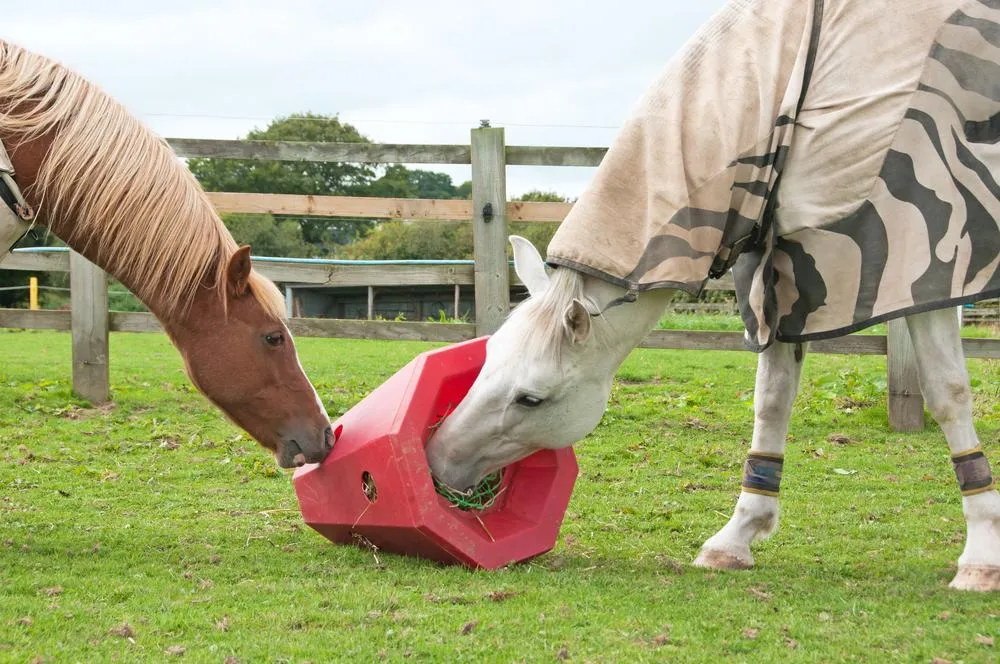
On another day, he might have some dry hay in a hay ball alongside his usual soaked hay. Changing how forage is presented gives him different opportunities to interact with his environment.
But there's another complication.
Blue is a native pony, a very good doer and currently needs to lose weight.
I therefore can't solve the enrichment problem by continually adding more food.
🍵 The water buffet that didn't quite go to plan…
During particularly hot weather, I've also experimented with a mini water buffet.
Alongside Blue's normal drinking water, I've offered different options including electrolytes in water and a homemade spearmint “tea” — simply spearmint steeped in boiling water and then topped up with cold water.
Blue drank…
Neither. 😂
Interestingly, though, he did seem to enjoy the soaked spearmint itself.
I think that's useful information.
Enrichment is an experiment, not something we simply provide and tick off a list.
I could decide that flavoured water is enriching because I think it's a lovely idea.
Blue is perfectly entitled to disagree!
So I'll keep experimenting with safe options and see whether there are other flavours he chooses to investigate.
🤔 Enrichment doesn't have to mean more calories
Managing Blue's weight has also made me think more broadly about enrichment.
Food-based enrichment is often the easiest thing to reach for, but enrichment can also be:
👃 sensory
🐴 social
🧠 cognitive
🪟 physical
That becomes particularly important when additional calories aren't appropriate.
It also means thinking about what the horse actually experiences rather than how inventive the enrichment looks to us.
I tried putting forage nuggets into a forage ball in Blue's stable, for example.
He pawed at it repeatedly and my interpretation was that he appeared to be becoming frustrated rather than calmly engaged.
So I stopped using it that way.
I might eventually try the same ball in his paddock and observe whether having more space changes how he interacts with it.
That's part of the experiment too.
💙 The right enrichment for THIS horse
In my previous Firm Foundations blogs, I talked about Blue being a cautious horse and why I'm deliberately not flooding his world with novelty.
That applies here too.
Novelty and enrichment aren't interchangeable.
Something new might encourage curiosity and exploration.
However, for an individual who finds novelty difficult, continually introducing unfamiliar objects could simply create more uncertainty.
So with Blue I'm trying to find the balance.
What encourages him to forage?
What does he choose to investigate?
What seems to sustain his interest?
What appears frustrating?
What can I introduce without making his environment feel unpredictable?
Also, what does he tell me about whether my supposedly brilliant enrichment idea is actually brilliant? 😅
🧩 Enrichment has to work for humans too
There's another part of enrichment we perhaps don't talk about enough.
It has to be sustainable.
I have hundreds of enrichment ideas.
But if something takes ages to prepare, costs a fortune or requires a complicated set-up every day, realistically I'm unlikely to provide it consistently.
I'd rather find several simple things that suit Blue, fit his dietary requirements and work within my actual life.
Scatter some of his existing ration around the paddock.
Change how forage is presented.
Provide safe opportunities to investigate and make choices.
Experiment, observe and adjust.
Because perhaps successful enrichment isn't about having the most elaborate ideas.
It's about creating meaningful opportunities that work for this horse, in this environment, at this particular point in their life — and that we can realistically continue providing.
The weather will change. 🌦️
The grass will eventually grow again.
Blue's needs and preferences may change too.
So perhaps the goal isn't to create the perfect enrichment programme.
It's to keep asking:
🐴 What opportunities is my horse's environment providing today — and what's missing that I could thoughtfully put back in?

Blog Posts Straight to Your Inbox!
What do clients say?

Amy D

We had an intro session on clicker training with Louise, it was fabulous, very informative. After reading up about clicker training and getting a bit confused with all the different approaches, Louise made it very clear and explained it all thoroughly.
Eiddwen S
I contacted Why Do Horses for help with issues I was having travelling my horse. During our sessions I found myself wanting to learn more about equine behaviour and body language and I have realised I was missing a lot of knowledge. Why Do Horses have changed my entire outlook on horse training and behaviour, this is something for which I will be forever grateful!