Love Reading?
Articles
Find our blog posts and media articles all in one place!
Why Contrafreeloading is a Gamechanger in Training
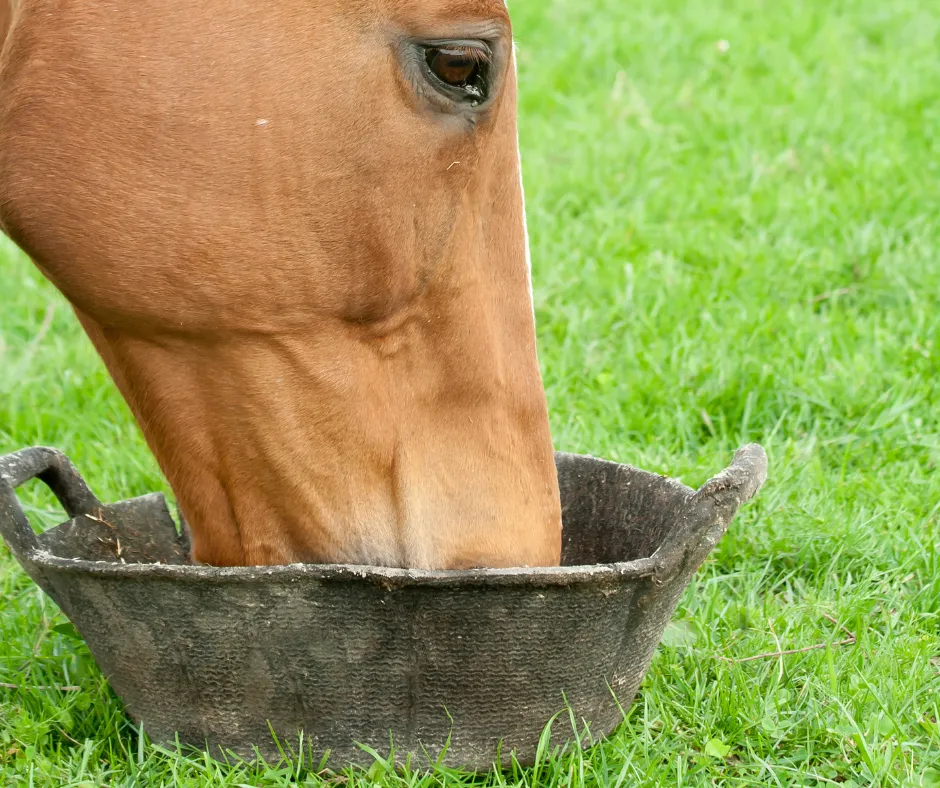
If you’ve followed my work for a while, you’ll know I’m a huge advocate for reducing stress, frustration, and over-arousal in training. One of my favourite tools for this? Contrafreeloading set-ups — especially the Break Bucket.
But what is contrafreeloading? Why do I choose to use it when training horses with food? Let’s dive in. 👇
🌱 Horses Haven’t Evolved to Wait for Food
When we step into a training session with a pocket full of food, we unintentionally become the gatekeeper of a very important resource. For predators like humans (and our dogs and cats), this dynamic makes sense. We evolved eating in meals, so waiting for food feels normal.
But horses? Totally different story.
Horses evolved as grazing herbivores, living in environments where food was abundant and spread out. Grass didn’t hide — and it didn’t have to be earnt. Their digestive systems and their behavioural ecology both reflect this:
They eat little and often, almost continuously 🌾
They rarely experience true food scarcity
They haven’t evolved the ability to wait for food after performing a behaviour — because that’s simply not how wild horses survived
So when we, as trainers, begin withholding food until a horse performs a specific behaviour, we can accidentally create stress. The horse isn’t “being rude,” “muggy,” or “overexcited” — they’re experiencing a mismatch between their natural biology and the demands of the training environment.
🔥 Why Stress and Frustration Build Around Food
If the horse’s only access to food comes through us, a lot of pressure lands on that moment of reinforcement. That pressure often shows up as:
Over-arousal
Tension
Mugging or grabbing
Frustration behaviours
Appearing “obsessed” with food
None of this means that positive reinforcement isn’t working — it means the environment is doing some heavy lifting in the wrong direction.
🪣 Enter: Contrafreeloading (and the Break Bucket!)
Contrafreeloading sounds complicated, but it’s beautifully simple.
👉 Freeloading = getting something for free
👉 Contra-freeloading = choosing to work for something even though you can get it for free
A contrafreeloading set-up, like a Break Bucket, offers food freely available at all times. The horse can walk away and eat whenever they want. No pressure. No competition. No scarcity.
And here’s the magic:
When the horse chooses to leave the free-access food and engage in the training task, it tells us everything we need to know about their emotional state. 🧠💛
🌤️ Reducing Stress by Supporting Natural Choices
With free-access food available, the horse no longer sees training as the only route to a vital resource. This changes everything:
✔ Training becomes about enjoyment, not necessity
The horse isn’t working for food — they’re working because the interaction is reinforcing in itself.
✔ The horse can disengage — which is a GOOD thing
If training becomes stressful or unclear, the horse can simply say, “No thanks, I’ll take a break.”
This is called a MAND — a type of communication where the horse requests something (in this case, free food or space).
Listening to MANDs is one of the most empowering things we can do as trainers. It gives the horse agency and it gives us vital feedback.
✔ We stop being the gatekeeper
No more pressure, no more scarcity. We’re no longer the only route to reinforcement — and that alone often softens the whole training picture.
🧩 Why Horses Often Prefer Contrafreeloading
Research across species shows that many animals choose to work for food, even when the same food is freely available. Horses do this too.
Why?
Because engaging in a task, exploring, and problem-solving are inherently enriching. It gives them control, agency and the chance to succeed — all of which support emotional stability.
When a horse chooses to take part, that choice holds far more value than any treat ever could.
💬 Final Thoughts
Using contrafreeloading set-ups isn’t just a training technique — it’s part of building a trust-based, low-stress, emotionally intelligent relationship with your horse.
By giving horses access to food at all times, we:
🌾 Reduce stress and frustration
💛 Support natural eating patterns
🧠 Encourage agency and communication
✨ Build training sessions based on joy, not pressure
The Break Bucket isn’t a gimmick — it’s a window into your horse’s emotional world.
When we listen to that world, training becomes richer for both of us. 💛🐴
If you'd like more information on how you can bring this level of clarity and choice into your training, drop me a message and let's discuss how I can support you and your horse!

Blog Posts Straight to Your Inbox!
What do clients say?

Amy D

We had an intro session on clicker training with Louise, it was fabulous, very informative. After reading up about clicker training and getting a bit confused with all the different approaches, Louise made it very clear and explained it all thoroughly.
Eiddwen S
I contacted Why Do Horses for help with issues I was having travelling my horse. During our sessions I found myself wanting to learn more about equine behaviour and body language and I have realised I was missing a lot of knowledge. Why Do Horses have changed my entire outlook on horse training and behaviour, this is something for which I will be forever grateful!